
Missouri Creek Stream Restoration
Project Overview

The 2021 study by Matrix Design Group identified the Missouri Creek sub-basin as one of the most at-risk areas in the Upper Clear Creek Watershed. The Missouri Creek sub-basin is in Gilpin County, upstream of North Clear Creek, Gilpin County High School, and the Missouri Lakes neighborhood. However, although the Matrix pre-wildfire planning study identified stream projects for larger streams and reaches, it did not evaluate smaller reaches like Missouri Creek, which runs along Missouri Gulch Road. Through the 2022 Senior Design Challenge program, Colorado School of Mines students are conducting preliminary field assessments, water quality and field data collection, and GIS analyses to recommend preliminary restoration designs in the Missouri Creek sub-basin.
Although the pre-wildfire planning study did not identify stream channel and floodplain projects for smaller reaches, two Forest Management projects (FM-34 & FM-35) were identified in the Missouri Creek sub-basin. These projects are part of the US Forest Service Yankee Hill Fuels Reduction project area, and must be carried out in partnership with the USFS. The CCWFHP is working on larger-scale collaborations with the USFS to accomplish forest management needs throughout the watershed and adjacent watersheds. Stream channel and floodplain projects will reduce impacts of post-fire runoff if a fire were to occur in the Missouri Creek sub-basin.
Mitigation Measures Proposed
CCWFHP plans to conduct a Request for Proposal process for final engineering designs for Missouri Creek stream restoration work, based on CSM 2022 Senior Design findings, including:
Dredge the pooling pond and mine waste piles between pond and stream.
Lateral stream movement to make the stream more sinuous.
Replace outlet culverts near the Pickle Gulch Campground.
Perform fuels reduction measures at the site.
Estimated Costs & Permitting
Costs and permitting needs are to be determined in the Request for Proposals process in Phase 2 (slated for 2023).
Phase 1: CSM Senior Design
Through the 2022 Senior Design Challenge program, Colorado School of Mines students are conducting preliminary field assessments, water quality and field data collection, and designing a stream channel restoration project on Missouri Creek, a tributary to North Clear Creek. The CSM Senior Design student team was asked to identify stream restoration and floodplain preservation locations on Missouri Creek using the same methods applied by Matrix: relative elevation models (REMs) and aerial imagery. The students also met with stakeholders about the project, including Blackhawk City Council meetings and the Upper Clear Creek Watershed Association.
Timeline: CSM students began work in Spring 2022, with an initial site visit in April 2022, and additional flow, water quality, and soil sampling in July, September, and October 2022,.
In December 2022, the CSM team provided 30% project design & restoration recommendation to the Partnership at the conclusion of their Senior Design project.
-
Prior to graduation, students at Colorado School of Mines complete a 2-semester engineering design project for clients in the community as an experiential learning process. Students are advised by clients and a faculty team from the university. Watershed management in the Clear Creek basin has benefitted from numerous Senior Design projects
-
Healthy stream systems provide protection to the overall stream system and the infrastructure and water users below it in post-fire scenarios. CSM students are using aerial imagery, site visits, and a relative elevation model to determine where sections of Missouri Creek may benefit from floodplain expansion and flow alteration. Restoration plans may include bank stabilization and restoration, floodplain connection and expansion, and natural channel designs such as rock cross vanes, constructed riffles, and log rollers to restore stream function.
-
In site assessments, the CSM student team found physical and chemical evidence of contamination from mining (dredging piles, orange soils and water, and lab-tested water and soil samples). They also identified damaged culverts creating issues in stream routing and increased erosion.
Mitigation Measures Proposed
CCWFHP plans to conduct a Request for Proposal process for final engineering designs for Missouri Creek stream restoration work based on CSM 2022 Senior Design findings, including:
Dredge the pooling pond and mine waste piles between pond and stream.
Lateral stream movement to make the stream more sinuous.
Replace outlet culverts near the Pickle Gulch Campground.
Perform fuels reduction measures at the site.
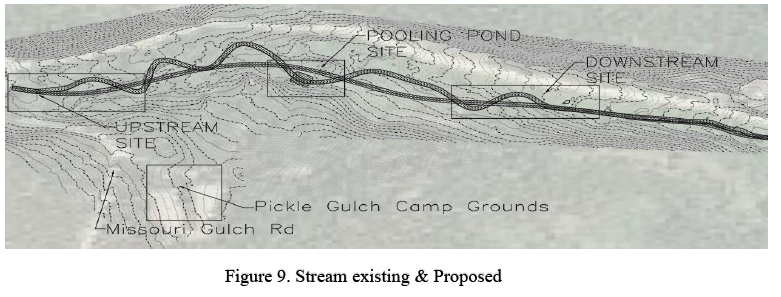
Birds-eye view diagram of proposed mitigation measures at Missouri Creek site — Figure 9 from the 2022 CSM Senior Design report.
Phase 2: Outreach & Full Design
In June 2022, the CWCB Healthy Rivers Fund grant program awarded $20,000 to support 1) final design engineering, 2) permitting, and 3) public outreach to facilitate implementation.
Timeline: The HRF funds were contracted in Fall 2022 and will be used in 2023 to conduct outreach on project design recommendations, and to contract an engineering-design firm following an RFP based on the CSM students’ design work.
-
-In March 2023, CCWFHP & partners in Gilpin County are holding an outreach meeting with stakeholders affected by the Missouri Creek project in the upper Clear Creek Watershed.
-Next, an engineering design firm is needed to finalize restoration project design, then pursue permitting/access agreements necessary to carry out the work.
Phase 3: Project Implementation
During Phase 2, the CCWFHP will begin coordinating implementation grant funds and matching dollars to support timely project implementation upon completion of the design and permitting process. More information to come on this step as Phase 2 progresses.